
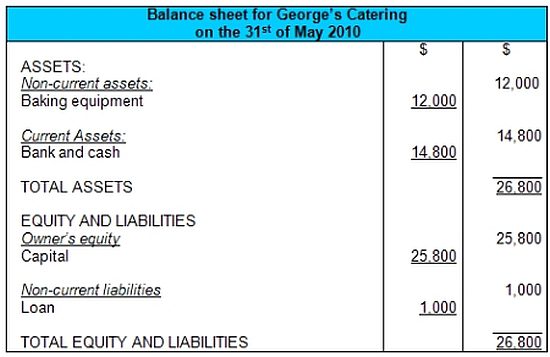
The company’s balance sheet, also known as the “Statement of Financial Condition”, reveals the company’s assets, liabilities and owner’s equity (net assets). The balance sheet, together with the statement of income statement and cash flow, forms the cornerstone of any company’s financial statements.
If you are a shareholder of a company or potential investor, it is important to understand the structure of the balance sheet, how to analyze it, and how to read it.
The balance sheet is divided into two parts, based on the following equations, and must be equal or balanced. The main formula behind the balance sheet is:
Assets = Liabilities + Shareholder’s Equity
This means that assets or means to be used to operate a company, balanced by the company’s financial obligations and equity investments brought to the company and its retained income.
Assets are assets used by a company to operate its business, and its liabilities and equity are two sources that support these assets. The owner’s equity (called shareholder equity in publicly traded companies) is the amount of funds originally invested in the company and any retained earnings, which represents the source of funds for the business.
It is important to note that the balance sheet is a snapshot of the financial status of the business (financial statements) at a single point in time.
Introduction to the balance sheet
Current assets have a lifetime of one year or less, which means they can be easily converted into cash. Such asset classes include cash and cash equivalents, accounts receivable and inventory.
Cash, the most basic current assets, also include non-restrictive bank accounts and checks. Cash equivalents are very safe assets that can be easily converted into cash; US Treasury is such an example.
Accounts receivable include short-term obligations owed to the company by its clients. Companies often sell products or services to customers on credit; these obligations remain in current assets accounts until customers pay them off.
Finally, inventory represents the company’s raw materials, ongoing work and finished products. Depending on the company, the exact composition of the inventory account will vary.
For example, a manufacturing company will carry a lot of raw materials, while a retail company does not have any raw materials. The composition of retailer inventory is usually composed of goods purchased from manufacturers and wholesalers.
Non-current assets are assets that are not easily converted into cash and are expected to convert cash into cash within one year and/or have a lifespan of more than one year. They can refer to tangible assets such as machinery, computers, buildings and land.
Non-current assets can also be intangible assets, such as goodwill, patents or copyrights. Although these assets are not material in nature, they are often resources that can create or destroy a company – for example, the value of a brand name should not be underestimated.
Also read: How to grow your business
Depreciation is calculated from most of these assets, which represents the economic cost of the asset over its useful life.
The other side of the balance sheet is liabilities. These are financial obligations that the company owes external parties. Like assets, they can be current and long-term. Long-term liabilities are debt and other non-DEBT financial obligations that shall expire at least one year after the balance sheet date.
Current liabilities are liabilities that a company is payable or must pay within one year. This includes shorter term loans, such as accounts payable, and current long-term loan portions, such as the latest interest payments for 10-year loans.
Shareholder equity is the initial amount invested in the enterprise. If at the end of the fiscal year, the company decides to reinvest its net income into the company (after tax), these retained income will be transferred from the profit statement to the balance sheet and into the shareholders’ equity account.
This account represents the company’s total net assets. To balance the balance sheet, the total assets on one side must be equal to the total liabilities add Shareholder’s equity of the other party.
Here is an example of Walmart’s corporate balance sheet, around 2016 (NYSE: WMT):
Source: http://corporate.walmart.com (2016)
As can be seen from the balance sheet above, it is divided into two main areas. The assets are at the top, and below are the company’s liabilities and shareholders’ equity. It is also obvious that the balance sheet is in equilibrium, with the value of the assets equaling the combined value of the liabilities and shareholders’ equity.
Another interesting aspect of the balance sheet is how to organize. The assets and liabilities of the balance sheet are organized in the current way that the account is. Therefore, for the asset side, the account is usually classified from most liquids into the least liquid. For the liabilities, the account is organized from short-term to long-term borrowing and other obligations.
With a better understanding of the balance sheet and how it is constructed, we can review some techniques used to analyze the information contained in the balance sheet. The main technology is financial ratio analysis.
Financial ratio analysis uses formulas to understand the company and its operations. For balance sheets, using financial ratios, such as debt-to-equity ratios, provides a good understanding of a company’s financial situation and its operational efficiency. It is important to note that certain ratios will require information from multiple financial statements, such as balance sheets and profit and loss statements.
The main types of ratios that use balance sheet information are financial strength ratios and activity ratios. Financial strength ratios, such as working capital and debt-to-equity ratios, provide information on how a company performs its obligations and how its obligations are leveraged.
This can give investors an idea of the company’s financial stability and how the company itself is funded. Activity ratios are mainly concentrated on the current account to show the management effectiveness of the company’s management cycle (including receivables, inventory and payables). These ratios provide insight into the company’s operational efficiency.
Balance sheets and statements of income and cash flows are important tools for investors to understand the company and its business. It is a snapshot of a single point of the company’s account – covering its assets, liabilities and shareholder equity.
The purpose of the balance sheet is to make interested parties aware of the financial status of the company, in addition to showing that the company owns and owes. It is important that all investors know how to use, analyze and read the balance sheet. The balance sheet can provide insight or reason to invest in stocks.
refer to
